Showing posts with label art. Show all posts

Sunday, 30 November 2014

Art: An open space for ideas


Art can be an exciting idea, not something one physically owns.  This is the spirit that drives the newly-opened Gallery SKE in Bangalore.

(This article was originally published in October 2003)


A shrinking community: Mahendra Sinh portrays the Parsi.

IF YOU'RE art-alienated, it's time to take a look at the new Gallery SKE, launched on October 18, an open space for ideas that could redefine Bangalore gallery trends. 

The brainchild of Sunitha Kumar Emmart, who earlier managed Sakshi Gallery, the space takes its name from her initials. Its contemporary, globally-styled area, bamboo greened beyond sheet glass, boasts of supporting wall text. The gallery opened with Mumbai-based Mahendra Sinh's black-and-white Parsi photographs that grow beyond documentation to lyrical insights.

"I learnt so much from the energy and experience of Sakshi's Geetha Mehra," says Sunitha, who'll be shuttling between Bangalore and the U.S. because that's where her American husband, Niall Emmart, runs a software company. "But while visiting private galleries in New York and London, I admired their strong, exclusive commitment to select artists."

So, Sunitha opted to focus on three artists whose work she had a gut feeling for — photographer Sinh, and Bangalore artists Krishnaraj Chonat, and Avinash Veeraraghavan. "When I moved to New York, I knew I wanted to be involved in Indian art, but I didn't know in what way. I needed a back-up space here," adds Sunitha.

Gallery SKE opens at a time when art as commerce governs media matters, when installation and innovation are replacing oil on canvas and standard sculpture, when art is defined by ideas, not conventions. "I admire Mahen for being such a stickler for detail, from the Ilford paper he prints on to the pasta he makes at home," Sunitha recalls. "He's taught me so much about photography."

What shaped her stance? "The commodification of art bothers me. With the lack of public spaces and museums here, I feel it's important for artists to have a dialogue with other people," Sunitha says. "Ten years down the line, I have a vision that younger people might want to support art, perhaps by lending transport to an international artists' camp like Khoj."


In a society that bypasses visual culture in daily life, how would Gallery SKE bring this about? By creating cross-strata children's workshops that unfold the secrets of colour or famous art. By staying open on Sundays, so that senior citizens can join their families en route to dinner or other destinations. By inviting the corporate sector to send its young employees to expand their art horizons. By enthusing schools to share a show, despite exam-centric pressures. By throwing open the gallery's collection of books/catalogues to art students. By organising artist juries to help young talent present work impeccably. Perhaps, even by training teenagers to curate their own virtual art shows, an idea Sunitha encountered at the PS One site, affiliated to New York's famed Museum of Modern Art (MOMA).

As a first step, Sunitha is planning 16-week annual educational modules, perhaps Sinh introducing the work of various photographers. "Art could be an exciting idea, not something you own in a physical sense," she stresses. "I joined the Young Collector's Council at New York's Guggenheim Museum. You're invited to their openings, after which the artist lectures on his/ her body of work. They even recommend books to follow up on a show."

Sunitha sketches in her approach to catalogues. Sinh's show engages us through poet-critic Ranjit Hoskote's essay, dramaturge Rustam Bharucha's response, and the photographer's own perceptions. 

In the future, she hopes to coax Canada-based novelist Rohinton Mistry to write the text for an expanded book of Sinh's Parsi visuals.

"I don't see myself as a curator, but I can identify people's potential. My skill lies in bringing talent together. I'm just the facilitator," concludes Sunitha, dreaming aloud for Gallery SKE. "People should be free to fix a time to come and discuss their ideas, whether they are finally formalized or not." 

(This article was originally published in The Hindu Metroplus, Bangalore, on October 27, 2003)

Thursday, 2 August 2012

Art: M Reddeppa Naidu ~ The magic of the Mahabharata

(1932- 1999)

(Note: I interviewed Reddeppa Naidu twice ~ once for Indian Express in 1985, then for The Independent in Mumbai in 1990. This piece is a composite of the two sessions.  I haven't been able to source visuals from his Mahabharata series so far, but promise to share them with this piece as soon as they come my way. )

*        *        *


        THE MAHABHARATA is open to interpretation by each individual Indian. What does it mean to you? An ageless epic? Classic rock sculptures in ancient caves? A popular television serial? A much-discussed, internationally-cast theatrical presentation? A tale related episodically by your grandmother?

        If you were a Madras-based painter named Mopuri Reddeppa Naidu, now 57, the Mahabharata would spell a series of 18 large canvases, one for each parva or canto of the epic, executed between 1972 and 1974. It would also mean a burgeoning friendship with M Deendayal, akin to him in age and social background, who encouraged the series as an admirer, patron and art gallery owner.

       Deendayal first exhibited Reddeppa’s impressive and stylized work at the Ashoka Hotel in New Delhi in 1974, then at his own Aparna art gallery in Madras in 1983. More recently, he hosted a retrospective of Reddeppa’s work in Madras.

       How did the great epic come to be captured on canvas? Naidu, relaxing at his modest home in Madras, replies, “Around June 1972, Deendayal read me a poem from the Stree parva ~ the Samsara Grahanam ~ which was translated into Telugu from Sanskrit in the 3rd century AD by Nanayyabhatt. He then requested me to do a painting based on it. I did one, which both he and his wife liked very much. Deendayal then suggested that I might like to do one for each parva.”

      Reddeppa is one of the most respected contemporary painters in south India, a winner of the coveted National Award in 1962, a student of D P Roy Chowdhury and K C S Panicker at the Madras College of Arts and Crafts. He is currently Deputy Director (Design) as the Weaver’s Service Centre (WSC) at Madras (now Chennai).

      Does his work in textiles draw him away from art? “There are no two ways about it. An artist remains an artist. He never goes completely into any other work,” replies Reddeppa, thoughtfully. “But the creative mind is common to both the artist and the textile designer. One complements the other. So, my primary object in taking up this job ~ besides the fact that it helps monetarily ~ is that it doesn’t affect my creative painting. It never distracts me from my canvas.”

      Does the WSC re-connect him with Indian tradition? “If I had not joined the WSC, I would not have known the greatness of our tradition because our art schools are so western-oriented. Re-doing through the mind forms done by past people helps to contact the living mind of the past,” he responds, drawing lines in the air. “Contact with such textiles greatly benefits the creative artist. He is used to free-thinking on a canvas. The same application on paper ~ a bird or a flower or a design ~ is given the same aesthetic expression and gives the same joy. No doubt, in conceiving a complete plan for a saree, an artist cannot design as he likes. He has to think of how it will go on the loom. But after years of working towards this, he can finally bring his personality into the saree ~ in its colour, border, pallav, its totality. Ultimately, he may achieve a simplification of the process, as in a painting.”

       Here are excerpts from an interview with Reddeppa, done in the context of the Mahabharata series:

     How have your techniques and idioms evolved to bring you to this point in your art?

      In the early 1970s, most south Indian painters were going through a romantic phase, greatly influenced by the French school of thought. This was reflected in my first two Mahabharata paintings. Earlier, in the Deity series which I began in the 1960s, I used dull colours, sensitive lines of modern expression and bright patches for emphasis. In their midst, I scripted relevant Sanskrit slokas. These were authenticated by a pundit, Ganesa Sastri, hired by Deendayal.

      After the Samsara Grahanam, Deendayal suggested the Sauptika Parva as the next subject. After the final destructive battle, which nobody really won, Asvatthama watches an owl entering a crow’s nest and destroying all the young ones while the other surviving Kauravas ~ Kripa and Kritavarma ~ were asleep. Inspired by this, Asvatthama steals into the Pandava camp, encounters Shiva and obtains his sword, with which he kills all the sleeping Pandava sons. Then, he accompanies Kripa and Kritavarma to tell Duryodhana of the enemy’s annihilation.

      (Pausing to gather his thoughts) These first two paintings in the series continued in the style of my Deity series. The artist has to find a vocabulary and colours of his own for the characters, and a philosophy for each parva. The question of the entire Mahabharata doesn’t arise. I had to choose an interesting poem from each parva and decide how to depict it.

    In the third painting of the series ~ the Sabha Parva ~ I needed to depict Duryodhana, Arjuna and Bhima pictorially. At this stage, I moved away from my earlier romantic paintings and my colours became brighter. While doing the Sabha Parva, I had to search within for a way of portraying the attempted disrobing of Draupadi. I drew her praying to Krishna, and then a thought came to me. I drew Krishna’s Sri Chakra around her sari to protect her. It’s not very cinematic, but it’s very satisfying to have found such a solution. 

    You’d studied Telugu and Sanskrit when you were young in Andhra Pradesh. Have you always been familiar with the Mahabharata?

    Not really, although I had read it in bits and pieces since my schooldays, seen it on stage and in films. Which edition did I finally use for the paintings? One I borrowed from Deendayal ~ a Telugu translation of the Mahabharata by Sri Mantri Lakshminarayanan Sastri.

    The Mahabharata elevates and takes the mind to great heights. When you read all that philosophy, it is reflected in your lines, your colours. My challenge was to read the epic, yet to be free of the epic. Only then could I do a creative painting.

      Look, I didn’t merely read the Mahabharata. I lived in it. In recreating it in a different medium, I lived through it. Today, I can talk consciously about the line, the colour and composition of the paintings. But, while I was working on them, it was all  unclear in my mind. I was trying to bring the unknown to reality. (Silent for a minute) Normally, one begins a venture with some expectations. The mind always works with a purpose, but I had to set myself free. I wasn’t painting for an award, or even for a customer. I could rise to the creative challenge because my mind was free of all preoccupations.

      Was Deendayal responsible for setting your mind free?

       He gave me absolute freedom. I was totally responsible for giving of my best. For each parva, I chose the incidents or episodes to be depicted. He didn’t interfere, not even to check on the progress of each painting, though I did show him a drawing on paper before I began each canvas.

     After each of the 18 paintings was completed, he’d send a vehicle for it. Then, we’d sit together and discuss it.

     How did you first meet Deendayal, an unusual patron in our competitive world?

      In 1979, Deendayal came to see a mural I had done for the industrialist T. T. Vasu, in Madras. He appreciated it so much that he began to share with me his joy in Tanjore paintings and other art objects from his private collection.  We became friends. His faith in my talent saw me through the Mahabharata series. There was no commercial aspect to this, but total mind-to-mind communication, such as there is when you like a person very much.

    Strangely enough, both Deendayal and I were about 40 when the Mahabharata paintings began in 1972. I feel that was the right age to get to know the great epic. By then, we already have some experience of life. Like me, he holds the conviction that the series should remain intact. He will never give away the series or break it up.

From his 'Musician' series


     What were your first encounters with religion-based paintings?

      The inspiration first came from a Muslim friend, Wazir Rahman, my classmate at the Kakinada High School. He wrote Telugu poetry.  One day in 1962, he said to me, “Look, Reddeppa, Balaji at Thirumala draws millions of devotees every year. I’m surprised that he does not seem to mean a thing to you.”

     I began to paint Lord Venkateswara with the sankhu, chakram and naamam… I realised that there was immense material in Hindu iconography, waiting to be exploited by a serious and responsible artist.

(This piece is included in my 2004 book, 'Articulations: Voices from Contemporary Indian Visual Art, published by Rupa & Co.)


Wednesday, 30 May 2012

Art: Khoj 2002 ~ The mind is a fertile field

Hema Upadhyay's letter to her parents sprouts in ragi

(I wrote this piece in 2002) 


Strappingh Michel Tuffery pats the tethered bull. "It tickles, does it?" he asks the large-eyed creature from a Mysore bovine sanctuary. "I won't hurt you. You're my Anna, I'm your little brother, your Thamba." Ritually tattooed from his waist to his knees, the Maori artist gently paints the bull's skinny shanks. Gradually, a tantalising red-and-black geometry emerges, while the artist and his work appear to blur into one.

"I feel visually spoilt in India," explains Wellington-based Michel, 36, at the Khoj 2002 International Artists' Workshop (October 19 to November 1) at Mysore's Le Olive Garden resort, that opened a local window into global art intersections. "Our family's from Samoa and Tahiti in the Pacific. From childhood, the cows and bulls of New Zealand have stuck in my head. But we've no respect for animals. When there's a water shortage, who suffers — the people or the bulls? To me, India seems like a Utopia for bulls."

As Michel erupts into a conceptually-motivated, masked "bull fight" on the Open Day, notions of art as painting or sculpture are collectively jettisoned. Taking off from a collage of corned beef cans blue-tacked to a wall, responding to an explosion of crackers taped to drawn bull-heads, he engages in a livewire performance that stuns the local populace. It signals a creative take-off, a careering off the beaten track, a time ripe for redefinitions.

But Michel wasn't unique among the workshop's 12 international and 12 Indian artists addressing individualistic concerns through local stimuli. In shifting the base of the high-profile, five-year-old Khoj artists' initiative from Delhi's Modinagar to the South for the first time, they engaged with "issues of new internationalism in the visual arts", according to a backgrounder. An offshoot of the Triangle Workshop in New York State in 1982, the brainchild of sculptor Sir Anthony Caro and collector Robert Loder, which resulted in the 1985 Thupelo Workshop in South Africa, Khoj represented the Indian colours of the enterprise.

What local stimuli did the artists respond to? Australia's Mandy Ridley, continuing her questioning of cultural identity through handcrafted objects, offered fluorescent plastic bags, each adorned with a contrasting rangoli cutout. Assaulted by a cacophony of Indian sounds, tantalised by alternate notions of beauty, Canadian academic and artist Gisele Amantea set up an audio piece of bathing sounds, juxtaposed against a delicate drawing of a pale hand captured between two mehndhi-rich ones. An intercultural exchange? Or donning The Other's identity? Maybe just cultural cross-dressing.

Closer home, Surekha from Bangalore struck gold at Mysore's Raju and Brothers studio. These reprints from old negatives, framed against red-bordered mirrors, unveiled the saga of the traditional jasmine braid that captures the cycle of Indian womanhood from birth to puberty, marriage and motherhood. Resonating touches in Surekha's continuing explorations of studio photography? A study blue curtain, and festivity-linked strings of blue lights.

Drawing on diaporic inspiration, Swiss-born Christoph Storz, who shuttles between Aarau and Bangalore, chose a vendor's trolley as his artistic tool after laboriously weeding a kolam-like path through a parthenium patch. "My art was homage to the local pushcart vendor," he elaborates, as marbles roll randomly on the trolley he trundles. "He sets out in the morning, not knowing which roads to follow or where his wares will sell. I was trying to explore his uncertain path."

Echoing Storz's frame of reference. Amsterdam-based and Mumbai-trained Mayura Subhedar, 29, tried to inject familiar feelings into an alien ambience by plastering a walled curve with rubbings of coconut palms and other artefacts from the resort, while studying the sway of shadowy fronds from a red oxide bench she built in. "My site-specific work relates to locating myself in a space," she explains. "I had to work my way through being a `foreigner,' so I had to jettison some baggage."

How did others cope with the workshop situation? Committed to socially-engaged practice, British artist Amy Plant treated her first Indian encounter as news by launching a tabloid, not as inquest but as inquiry. What appeared on its pages? Snippets of Khoj interludes. An interview with a local snake-catcher. A report on a burst pipe onsite. "It gave me a sense of the fabric of the place. So, I became a bit of a local myself," confesses Amy.

But, as local art students and lookers-on alike asked, did these free thinking experiments beyond the studio space constitute art? Or were they just radical departures from received notions? Such as the looped video installation by New Delhi's Ranbir Kaleka, 49, long based in London. Drawing on Mysore's Rangayana repertory theatre, he dramatised a very-Indian, quirky narrative, captured through painted wooden window frames, threaded through with appropriate Hindi film songs. "I treat video art as a democratic tool, almost like a sketch-pad, toying with ideas I've had for a while," Ranbir offers. "In India, video art still lags behind the West. It's useful to look at art within its age, time and context."

At Khoj, the theatrical found new interpretations through H.K. Dwarkanath, a stage designer at Rangayana, and Bangalore's Babu Eshwar Prasad, known for his elemental symbolism on flat hued canvases. Realised three-dimensionally, highlighted by theatrical lighting, Babu's set-like visual metaphors quickened to life by night. Inspired by the Mysore royal family's black-and gold carriage onsite, Dwarkanath mined their palace for inspiration. The result? An array of ghost-like plaster hands, shrouded in pale netting, sprout almost organically from the grass. Could they be supplicants for royal flavours? Or merely palace hands at work?

Other works took more topical, even political, cues. Sri Lanka's Sarath Kumarasiri touched on the ongoing Cauvery water dispute through swathes of flowing terracotta and blue cotton that unrolled onto a rocky incline, swathed in recent headlines. As literal, but more provocative, was an installation by Nigeria's Jacob Jiri, who garlanded a photograph of a baby abandoned in a dustbin, footnoted by a "soiled" sanitary towel. "I was making a statement, however offensive, about population control, provoked by the streets of Mumbai and Mysore," he stresses. What of the Gujarat strike? It surfaced in Baroda-based printmaker Vijay Bagodi's tented work, where sickles assume weapon-like overtones.

Alternate voices, couched expressively? Ragi sprouts from the soil reveal a letter to her parents in Baroda from Mumbai's Hema Upadhyay, a new turn to communications networks. Stridently, her citymate Reena Saini cues her uterus-based symbolism into an engagement with national integration through locally-crafted, tricolour-hued, natural fibre shapes strewn with rusty tools that flow over the floor like a river in spate.

Malaysia's Chang Yoong Chia installed moulded figures glued to the idiot box at the base of grouped coconut palms, in a "not conscious comment on urban lifestyles. While the TV is both intimate and universal, there's less intimacy between people today."

Often, complex issues surfaced through personal contexts. These included the Nix Art Museum by Bangladesh's Mahababur Rahman, a transparent tent studded with camouflage garments and war toys, in a pacifist statement buttressed by the auteur's cycle-borne daily performances. Bangalore's Biju Jose paid tribute to his late father's unlauded mechanical engineering drawings, propped like a musical score on stands that rose and fell to the shape of the backdrop of the Chamundi Hills, with a live horse installed by flickering lamplight to enhance realisation.

Dissimilar dimensions? The beauty versus ornamentation debate was realised by Brazil-born Berlin artist Carla Guagliardi's unadorned, curved red brick walls, offering "different feelings of space, newer perspectives of the same old thing", enhancing her exploration of spaces and water properties in Brazil and Europe. Enthused by Mysorean strands, Bangalore's Smitha Cariappa visually interpreted the local silk industry, transformed into hut-like spaces embellished by rangoli, hanks of silk, and symbolic silkworm evolution. N.N. Rimzon from Thiruvananthapuram, known for his innovative installations, chose a quieter note at Khoj — a series of locally-derived, yet tentative, drawings.

On another plane, Shambhavi from New Delhi chose to extend her horizons through a startling disc of rich blues and browns, made of iron, wood, cotton cloth, acrylic, graphite and oils, hung from the rafters. A neon-studded lamp enhanced the perspective, aided by fluttering pigeons on the beams.

Perhaps the most unusual participant at Khoj 2002 was Tibetan traditional painter Penpa Yaseel, 28, from the Tashi Lhundo monastery at Bylakuppe. Sitting amidst the silken splendour of gorgeous thangkas, Penpa explains, "I was trained in this style when I was 13. I came to India in exile in 1996. I'll never tamper with our sacred paintings, but I now feel I can do any kind of painting, maybe even depict Tibetan lifestyles."

Can art remain infinitely open-ended in our questioning age? When will its borderlines with technology blur forever? Can Khoj-like camps generate global amity? These questions remain unanswered despite the questing at Khoj.

As Khoj's central coordinator Pooja Sood observed in a recent brochure, the communal enterprise that has touched over a hundred artists is "more in the nature of an impetus rather than a period of sustained reflection". Ranbir concurs, "Workshops like this can stimulate thought, though perhaps not complete execution." A germ of thought that could sprout to fruition in the future?

(The Hindu Sunday Magazine 2002)

Saturday, 19 May 2012

Art: Thota Tharani ~ A symphony of strokes

Tharani: a time to take stock

(This article appeared in 2002)


THOTA THARANI means many things to many people. Some know him best as the artist who has held an exhibition of his work every year, a promise he had made to himself after college. Some admire him as the Swarna Kamal-winning art director for films such as Nayagan, Mouna Raagam, Sathya, and Anjali. 

Some are smitten by the naturalistic colour drawings that resulted from his stint at the Banasthali Vidyapith in Rajasthan in 1971. Others were moved by the spontaneous colour sketches on black that he executed over sleepless nights in response to the early strife in northern Sri Lanka, briefly on view at the Sakshi Gallery in Chennai. Some think of him as shy, retreating and introverted, while others try to puzzle out his secret life. Yet, he was credited with the décor for the wedding of Jayalalitha's "adopted" son years ago.


Symphony of Life, an ongoing exhibition of Chennai-based Tharani's paintings at the Lakshana Art Gallery at Race Course Road from September 5 to October 3, proves to be equally puzzling. A display of works done in the year 2000, selected from the gallery's acquisitions, it captures the artist in a time warp of his own making, unusually for a spirit as creative as Tharani.

For each of the paintings at the gallery link back to series by Tharani that are familiar to the eye from the 1980s or 1990s - Force or Symphony or Symphony of Life. Explaining the impetus behind the music-inspired series, the late Chennai-based art critic Josef James wrote: "Tharani moves to the intuitive sense of harmony, rhythm, and continuity to integrate his urges for freedom and refinement. Music generally and symphonic western music particularly have been his inspiration for these spirited excursions. It gives out much colour, in bold harmonies, flashed out in each instance, over strong linear rhythms."

The acrylic colours on canvas spring with gay abandon through the multi-hued borders holding them in, as if seeking to intermingle in free-spirited exultation. Colours so joyous and all-pervasive can seldom be contained by a title, but Tharani tries. The Symphony series began while Tharani was travelling in France in 1976.

"This is my response to the orchestration of music, mainly western classical instrumental. I hear music and I love music, but I don't know anything about music, so don't ask me for details," Tharani had explained during a 1988 encounter. "In Indian music, see, there is either one sitar or veena or tabla; it is a solo thing. Whereas, a western classical orchestra has 60 to 100 violins, about 10 to 20 cellos, and guitars and pianos. There is a lovely break-up of sound that I was interested in. You listen to the music, pick out the notes you need, and make of drawing of it. Then, playing the music, put on the colours. I can identify certain pieces which are influenced by Tchaikovsky's Nutcracker Suite or The Four Seasons by Vivaldi."

To Tharani, technical innovation has always mattered as much as execution. In his Delhi-born Force series, for instance, inspired by a tornado that hit Delhi in 1978-79, different strokes were initially etched on a metal plate, which was broken up - as if from the impact of a cyclone - before the final print was made. Later, in 1987, he chanced upon the Chinese Tangram, the square cut into six triangles, a rhomboid and a square, which fed into the series as patterns in water colour.

The border has always been a crucial element in Tharani's paintings and drawings. It suggests a work that is larger than its actual size, he says, especially when strokes break out of its boundary. This device is much in evidence in the current series, with its patches of colour broken through by lines of contrast that catapult through the often rainbow-like frame. Perhaps offering variants on perspective. Or celebrating the moods inherent in symphonic evocations of a score.


While Tharani's work in cinema has won him accolades and recognition, including the Padmashri, he has always been at pains to keep his art direction distinct from his art. While the former is characterized by extraordinary realism, his paintings are decidedly abstract by choice, defining the borderlines with clarity.

Perhaps the Symphony of Life series does not represent Tharani at his best. Perhaps it is just an interlude between creative phases. Perhaps the artist needed to re-assess the familiar before he ventured into unknown terrain. Perhaps the 2002-launched gallery was limited by its access to Tharani's more creative oeuvre.

No matter what the reason, when the viewer leaves Lakshana, he or she carries with her an unresolved puzzle.

"An artist is free. I don't want to be trapped by one subject or a single style," Tharani once declared. "The best thing is to do what you want to do when you want to. I give myself gaps between subjects, often returning to one every two or three years, to avoid boredom and to prevent myself from getting stale."

What has Thota Tharani done in his artistic life since the year 2000? That's an answer Bangaloreans look forward to with anticipation.

(The Hindu Metroplus Bangalore 2002)

Friday, 11 May 2012

Art: S G Vasudev ~ A celebration of life


Portrait by Mallikarjun Katakol

 (This interview took place in March 1992)

HIS EARLIEST artistic memories are of his mother, who painted cutouts and figures for a family Dussehra in the old-world city of Mysore, where life flows at a timeless pace. Her colours and brushes, amidst the festive bustle, fascinated him. But there were other moments, other icons. The child would watch agog as his uncle worked with his stretched canvases, and he would tune in to tales of how his great-grandfather ~ an ayurvedic doctor ~ had sculpted in stone.

Inevitably, despite parental opposition, the boy defied the family to study art.  The passage of time has  moulded him into an artist named S G Vasudev. A founder-member of the Cholamandal artists’ village, outside Madras, he presents his recent drawings ~ titled The Line ~ at the Pundole Art Gallery in Bombay till March 21, 1992.

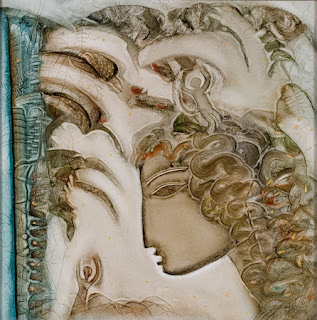
What is special about Vasudev’s line drawings? Unrestricted expression imbues their flow and play. Momentary ideas, like stray strands, intertwine, then veer apart. Moods beckon, then disperse, summoning up colours through fluid, circuitous lines.

Thematically, both integration and individualism come to the fore. Man and beast, tree, reptile, earth, sky and fruit, evoke a celebration of life through their inherent contradictions and alliances. In Vasudev’s world, each element is placed within its special orbit, both at ease with itself and with each other. Communing with this imaginary natural universe, the artist is immersed in belonging, never an outsider.

Vasudev’s work has meandered through many themes and media down the years. His mastery of oils, copper reliefs and the line have traversed Fantasies of real and unreal forms, Maithuna or the act of love, the Vriksha series that flowered for years, and the more recent drawings of He and She.

His is a multi-faceted talent. His paintings have been exhibited all over India, in addition to Havana, Paris, Brussels, Vienna, Prague, and New York. He was the art director for the award-winning Kannada films Samskara and Vamsa Vriksha. He has designed book jackets for writers like A K Ramanujam, U R Ananthamurthi and Girish Karnad.

How does the world view Vasudev? As one of the most popular and hospitable people at Cholamandal. As a tender and devoted husband to fellow-artist Arnawaz before cancer took her life in 1988. As an individual who cares passionately about art in a technology-centric world. 

In conversation, Vasudev couches his strong views in a gentle voice that seldom rises to a shrill treble of protest or defiance or anger. His spatulate fingers shape nuances in the air as he elaborates on an answer. He seems to be poised in mid-career, all set to take wing.

Here’s a pen portrait of the artist as a gentleman, not yet engulfed by the call of commerce:

Was the painter K C S Paniker, your principal at the Madras Government College of Arts and Crafts, a major influence on you?

When I got a national scholarship for painting in 1964, I joined directly under Paniker. (Wistfully) He never made us feel he was a teacher; he was a friend, philosopher and guide to me. His studio was always open, and I could talk to him about anything. It was good to discuss our work every day with a teacher of his standing. He’d talk about his own painting, and how the arrangement in my painting was helping him with his! It was as if both of us were learning at the same time. He gave us the freedom to work as and when we wanted to.

He gave a very good direction to those who were his best students ~ Viswanadhan, Adimoolam, Bhaskaran, I ~ because he felt we could build a very good centre in Madras. He’d even help us out with personal problems that we could not discuss with our parents. Gradually, that’s how the idea of Cholamandal came about…

Now that Cholamandal is 25 years old, what do you feel has gone wrong between the dream that was and what exists now?

Look, in the 1960s, there was no financial or media support available for us in Madras.  We were in our twenties and willing to work very hard to build up Cholamandal. But as we grew older and as some of us became successful, problems like jealousies and friction were bound to arise. And, in a small place, everything tends to get magnified. (Thoughtfully) But I feel Cholamandal has succeeded in what Paniker set out to do. He felt if 30 to 40 painters, living together, could produce five or six artists of some calibre over the next 20 years, Cholamandal would have served its purpose. It has.

You know, people always think of Cholamandal as a school. They’ve never understood that it is a community in which every artist is an individual.

Did it make a difference to Cholamandal to have a woman artist like Arnawaz in its midst?

If Arnawaz hadn’t been there, Cholamandal would have been totally different. One strong, outspoken woman like that changed the basic attitudes and concepts of people around. Otherwise, most of the other artist’s wives were very timid.

Now, I’m glad a strong person like painter Subha De lives in Cholamandal. I know most of the artists are not very comfortable when Subha talks to them because she has such strong opinions. But it’s good for them. They should argue things out.

Is something major happening in the world of Indian women painters today?

Well, it’s great to see artists like Rekha Rodwittiya, Vasudha Thozhur, Nalini Malani, Arpana Kaur, Arpita Singh and Jayashree Chakravarthy, confident and proud of their work. I admire their strong personalities, their statements, their involvement.

I don’t know how their husbands have taken their success, though. For instance, Arpita’s husband, Paramjit Singh, is a very popular painter. But Arpita is better known than him now…

What childhood experiences shaped you?

My earliest impressions are of my mother in Mysore, where I was born in 1941. She was an amateur painter of realistic, impressionistic subjects, including landscapes and fairly good copies of masterpieces. Most of her work was done before we were born. By then, she had already won some major awards in Mysore. After her marriage, she settled in Bangalore. She probably inherited her talent from her grandfather, an ayurvedic physician, who painted and sculpted in soapstone.

What were your initial yearnings towards art like?

I drew a little when I was very young, but nothing very special. I attended a college in Bangalore to do my B.Sc. because my parents wanted me to, but I never completed the course. In college I often did caricatures and cartoons of political and cricket personalities. I loved the game and drew G S Ramchand, Polly Umrigar, Hazare, Vijay Merchant…

I was influenced by the famous British cartoonist David Low and copied his style. My pen sketches were published in prominent publications of those times, like Samyukta Karnataka, Prajamata and Thainadu.

What brought you to arts college?

The well-known art critic in Bangalore, G Venkatachalam, helped me to go to arts college. He persuaded my parents to send me to the Government College of Arts and Crafts in Madras in 1960 and gave me a letter of introduction to Paniker.

My father used to send me some money, but it wasn’t sufficient. I didn’t want to ask him for more, so I earned extra money by drawing and doing stylized headlines for the Kannada edition of Soviet Land.

I was surprised when the national scholarship for painting was awarded to me. For the next two years, I had to choose someone as my mentor, I chose Paniker. We worked till late at night. We talked for hours. It was Paniker who taught me about the creative removal of colours. He’d say, “You can have any number of colours on a canvas. What is important is how to restrict or remove them…”

When I returned to college after a two-year scholarship, my new class included a young Parsi girl, Arnawaz, whom I later married. 
She and Tree, 61 x 61cm, 2006


Would you be able to trace phases that your work has traversed?

At college and just after, I did a series called Fantasies, which were thick impastos with lines scooped into the surface. I created fantasies from real and unreal human forms, birds, mountains, shells…

Around 1969, I began a series on Maithuna or the act of love. Yes, it is an old theme in painting. Perhaps I started on it because I had met Arnawaz. (Dreamily) To me, maithuna is not just about man and woman, but also about the sun and the moon, the earth and the sky, the stars and the clouds. My world is animistic. In it, bird and reptile, fish and fowl, seed and fruit, man and woman, live together in undulating hills and peaks seething with life.

Once in Dharwar, I came across the Kalpa Vriksha Vrindavana, a work by the modern Kannada poet D R Bendre. The kalpavriksha or Tree of Life soon grew to take centre-stage in my work. It was drawn from Indian myth. Later, at an exhibition in Delhi in the 1970s, someone asked me if I had read Roger Cook’s book, The Tree of Life. When I read it, I realized that all religions and most artists and craftsmen have used the tree as a motif at some time or the other. Take Mondrian, Miro, Klee… In Indian mythology, we have the Bodhi tree.

All these elements went into the making of the series and later copper reliefs, after I learnt repousse from Kuppuswamy, a traditional craftsman who came to stay in Cholamandal after retiring from the art college.

In 1983, when Arnawaz fell very ill, my tree took in the cycle of life, death and rebirth. Though I never consciously thought about it, it grew to become the Tree of life and death. Then, for nearly four years, I didn’t have any exhibitions in India.

But over 1989-90, many things I’d already done over the past 10 to 15 years came back to me. I found I wanted to paint. I wanted to get things out of my system. In some of my recent work, you can find influences of my earlier work.

For instance, I was always fascinated by portraits while in college. In trying to break away from the tree motif some years ago, I brought in a human element. The tree is still there, but the head is now becoming more prominent in my work. The heads grew into two new series of drawings ~ He and She.

In late 1989, I’d designed the sets for B V Karanth’s production of Girish Karnad’s Hayavadana in New Delhi. That set me off on a series of drawings with the same title. Do you remember how the main character in the play sets out in search of a human head?

Theatre of Life, 91 x 91 cm, 2001


Why is it important for a south Indian artist to exhibit in Bombay and Delhi?

If I’d exhibited my work in Bombay or Delhi more often, it would have made a difference to my career. I would have been better known because that’s where one gets maximum publicity and commercial success. Because there’s so much of all-India publicity generated from these cities, it’s not important for a north Indian artist to come south, though.

I felt this when, after three or four successful shows in Bombay between 1967 and 1974, I didn’t exhibit there for a while. When I went back to visit after shifting to Bangalore, I found everything had changed in Bombay ~ attitudes to art as an investment, prices for work by my contemporaries had rocketed…

I’d always fixed my prices according to lifestyles in Madras, and then Bangalore. I realised that artists who’d come five or ten years after me were selling more than I was. It’s not that they were better artists; it’s just that they were in the market. That’s why I want to exhibit in Bombay and Delhi more often.

Given the current worldwide recession and the state of the Indian economy, is the current system of pricing art justified?

In India, Bombay decides the prices. Pricing a painting high in India doesn’t make sense because you’re not really helping work to get into many homes. You’re confining it to industrial houses or the homes of the very rich.

If an artist like Tyeb Mehta does only four or five works a year, I can understand him pricing each very high. But what about others, who paint 20 to 30 works every month? (Excitedly) Why should each of their paintings sell for one lakh? Is it necessary? Will they be able to sustain their prices?

This places an artist like me in a dilemma. I can’t have one price for Bombay, another for Madras. I’d like even the average middle-class person to buy my work. So, where should I place myself?

(The Independent, Bombay/ Mumbai, 1992)